

Technology
Alpha Edusoft Offline ERP vs Cloud-Based School ERP Software: Which Is Better for Schools in 2026?
Compare offline campus ERP with cloud school software—cost, uptime, data control, and daily fee counter work for Indian institutes in 2026.
15 Jun, 2026
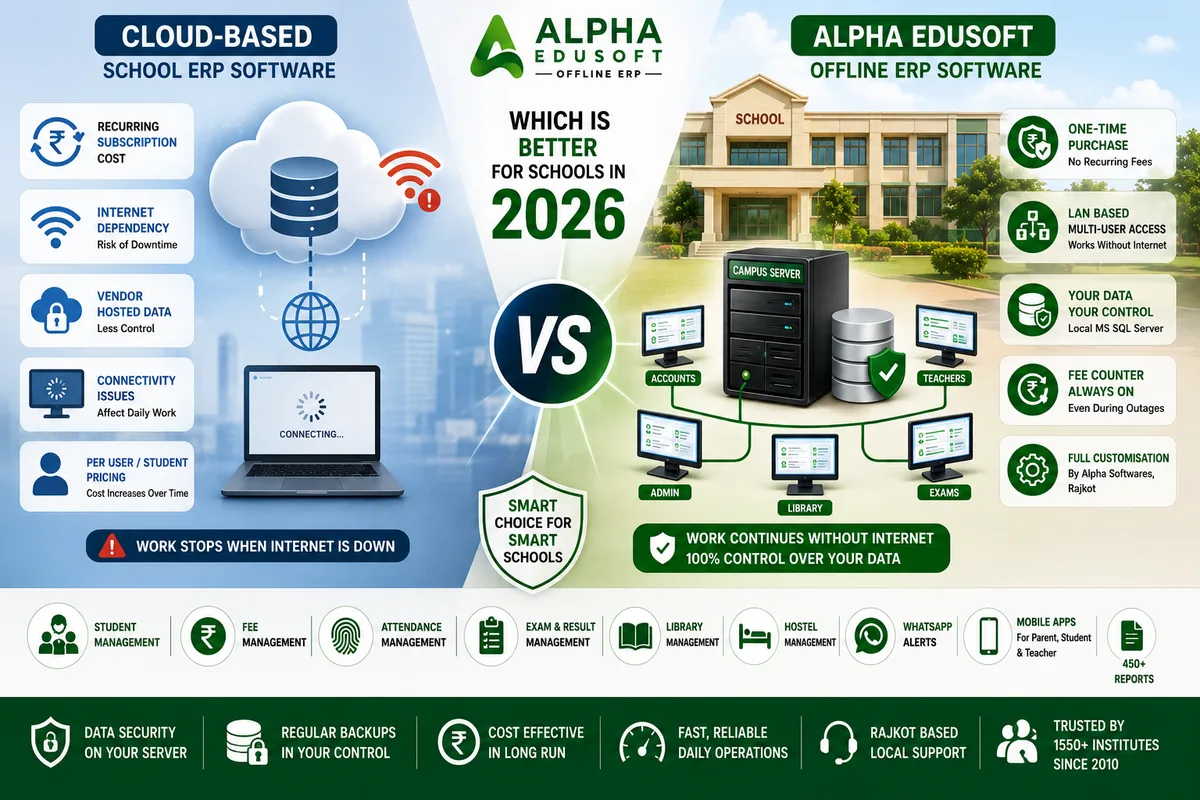
Choosing school ERP software in 2026 is no longer only about features—it is about how your institute runs when the internet drops, when fee counters are busiest, and when you need multi-year records for CBSE or GSEB compliance. Alpha Edusoft Offline ERP and cloud-based alternatives both promise automation, but they solve different operational realities for Indian schools.
What schools actually compare in 2026
Principals and trustees typically evaluate three layers: daily reliability at the fee counter and exam desk, total cost over five to ten years, and who controls student and accounts data. A school ERP comparison that ignores these points often leads to surprise subscription bills or downtime during result season.
- One-time purchase vs recurring monthly or annual cloud fees
- Campus LAN uptime vs internet dependency for core work
- Local MS SQL backups vs vendor-hosted data storage
- Multi-user access on multiple PCs without per-seat cloud pricing
- CBSE, GSEB, and board report formats ready on day one
Offline ERP vs cloud ERP at a glance
Offline vs cloud school ERP — typical differences
| Factor | Alpha Edusoft Offline ERP | Typical cloud school ERP |
|---|---|---|
| Core daily work | Runs on campus LAN without internet | Usually needs stable internet for login and saves |
| Cost model | One-time setup; lifetime usage for core modules | Monthly or annual subscription per student or user |
| Data location | Your server; you control backups | Vendor cloud; access via their policies |
| Fee counter during outage | Continues on local network | May stop if connectivity fails |
| Long-term records | Year-wise archives on your SQL database | Depends on plan retention and export rules |
| Customisation | Local implementation by Alpha Softwares, Rajkot | Often limited to vendor configuration tiers |
When offline ERP fits Indian schools better
Schools in tier-2 and tier-3 cities, campuses with weak broadband, and institutes that process high cash fee volumes often prefer offline ERP software. Alpha Edusoft keeps attendance, fees, exams, and parent SMS on the same campus database—so accounts, admin, and teachers work in parallel without waiting on external servers.
When cloud ERP may still make sense
Fully online institutes, small coaching centres with a single admin user, or groups that want central dashboards across many cities without local IT may lean cloud-first. Even then, ask how fee collection, hall tickets, and board reports behave offline or in low-bandwidth conditions before signing.
Why Alpha Edusoft remains a strong offline choice
With 1550+ clients since 2010, Alpha Softwares from Rajkot supports LAN-based multi-user ERP with student, staff, fees, exams, library, hostel, WhatsApp alerts, and mobile apps—while core administration stays on your server. That combination is why many Gujarat and pan-India schools still rank it among the best school ERP software options for 2026.
Explore all modules, pricing in INR, or request a demo with our Rajkot team.
Ready to simplify your institute management?
Discover how Alpha Edusoft Offline ERP can simplify attendance, fees, examinations, communication, and daily administration—without internet dependency.
Since
2010
Clients
1550+
Support
Rajkot
Frequently Asked Questions
Is offline ERP outdated compared to cloud in 2026?
Not for institutes that need fee counters, exam desks, and admin offices to run without internet. Offline ERP on a campus LAN is still the practical choice when uptime and data control matter more than browser-only access.
Can Alpha Edusoft send SMS and WhatsApp if it is offline?
Core records and daily work run on your LAN. SMS and WhatsApp integrations use connectivity when sending alerts, but fee collection, marks entry, and reports continue locally.
How do we compare total cost over five years?
Add subscription fees, per-student charges, renewal costs, and hardware for cloud plans. Compare against one-time offline setup plus local server maintenance—most schools find offline ERP lower over a five-year horizon.